'Lights Out' META
How platform policies impact democracy
Newsroom analysis of corporate behavior and worker impacts
What is 'META'?
META (formerly Facebook, Inc.) is a major American technology company that owns Facebook, Instagram, WhatsApp, Messenger, and Threads. It has a heavy focus on developing the metaverse, AI, and virtual reality (VR) technologies.
In 2025, META's net income was approximately $60.5 billion.
Rebranded in 2021 to reflect its focus on, "the next evolution of social connection" beyond 2D screens, it reported 3.54 billion daily active users across its apps as of early 2026.
META makes most of its money through advertising, with 97.8% of revenue coming from ads as of 2023.
Sales of Quest headsets, Ray-Ban META glasses, and VR software make up about 1.5% of revenue, as of January 2026.
META CEO Mark Zuckerberg has continued to face scrutiny over the company's content moderation policies, with critics accusing the platform of amplifying far-right rhetoric.
Reports highlight concerns over META’s enforcement inconsistencies, particularly around election-related misinformation and hate speech. Advocacy groups, including Media Matters and the Anti-Defamation League, have documented instances where META’s algorithms appeared to favor divisive content, reigniting debates over its role in political polarization.
The "'Lights Out' META" protest, which initially called for advertisers to boycott the platform, has since evolved into a broader campaign urging regulatory intervention. According to Bloomberg, organizers have partnered with lawmakers in the EU and U.S. to push for stricter oversight of META’s policies. Meanwhile, internal documents leaked to The Verge reveal ongoing tensions within META, with some employees questioning leadership’s commitment to curbing extremist content.
The company ended third-party fact-checking in the United States and scaled back content moderation on political discourse. Recent updates to META’s policies on hateful conduct now allow LGBTQ individuals to be labeled "mentally ill" based on their innate identities.
While 'Lights Out' META looks at social platforms, Grassroots resistance focuses on real-world protest and community-building.
Support advocacy orgs that study digital rights and platform accountability often have more influence than individuals acting alone.
These groups conduct research, organize campaigns, and often testify before lawmakers.
META’s international secrets
Here is a compact set of articles covering suspected links between Facebook or Meta-owned platforms and offline violence outside the United States. Includes news reports, institutional analysis, and human-rights reporting.
Myanmar
- U.N. investigators cite Facebook role in Myanmar crisis — Reuters, 2018. Reports U.N. investigators’ claim that Facebook helped spread hate speech and played a “decisive role” in intensifying violence against the Rohingya.
- As Facebook addresses role in Myanmar violence, look back at early warnings — PBS/FRONTLINE, 2018. Discusses Facebook’s alleged role in spreading hate speech, disinformation, and calls for violence, along with warnings the company received.
- Facebook and the Rohingya genocide in Myanmar — Journal article, 2025. Reviews the evidence and competing interpretations concerning Facebook’s contribution to anti-Rohingya hate campaigns and genocide.
Ethiopia
- Facebook’s algorithms ‘supercharged’ hate speech in Ethiopia’s Tigray conflict — BBC, 2023. Reports Amnesty International’s allegation that Facebook’s algorithms amplified harmful rhetoric targeting Tigrayans during the conflict.
- Facebook’s content moderation failures in Ethiopia — Council on Foreign Relations, 2022. Examines Facebook posts calling for violence and their alleged connection to riots following the 2020 assassination of musician Hachalu Hundessa.
Sri Lanka
- Facebook can’t resolve conflicts in Myanmar and Sri Lanka on its own — Brookings Institution, 2018. Covers Facebook rumors and anti-Muslim posts that allegedly helped inflame communal violence, including the 2018 attacks in Sri Lanka.
- Where countries are tinderboxes and Facebook is a match — The New York Times, 2018. Reports how false rumors and Facebook groups were alleged to have contributed to anti-Muslim riots and assaults.
Brazil
- Come to the ‘war cry party’: How social media helped drive mayhem in Brazil — The Washington Post, 2023. Examines the use of Facebook and other social platforms to promote mobilization and violent attacks on Brazil’s government buildings.
Are boycotts effective?
Studies find boycott attempts are successful 25-40% of the time. However, boycott attempts only get analyzed after they’re getting some traction, and corporations don’t always follow through on their promises. So all we can say for certain is that boycotts lead to substantive changes often enough for activists, customers, and corporations to take them quite seriously.
Why boycotts like 'Lights Out' META work
- They cause reputational damage that corporate leaders fear.
- They lower stock prices and hurt sales.
- They attract national media attention quickly.
- Private consumer choices can harm a company even before public headlines appear.
- They shift the calculus of third parties like advertisers, retailers, investors, suppliers, and talent.
- They signal and coordinate dispersed people to act collectively.
"Yale Insights" (new tab/window)
"From Target to Disney, 2025 proved boycotts work" (new tab/window)
Tech against democracy
Author Rebecca Williams exposes the corrosive results of big tech's power:
While reclaiming the tools is necessary, poetic, and a little meta, it is not sufficient. ... If the deeper problem is that technology has atrophied our civic muscle, then better technology alone won’t rebuild it. The imagination and community-building power of the cultural revolution can help us imagine another world; the next question is how to turn that community into political power.”
"Unwinding the Great Tech Power Grab" (new tab/window)
Are working people in the crosshairs?

Are you next? Controversial new policies at META have alarmed the public.
META CEO Mark Zuckerberg drew criticism after aligning the company with far-right politics. This resulted in the “'Lights Out' META” boycott. It targeted platforms including Facebook, Instagram, Threads, and WhatsApp.
META has ended third-party fact-checking in the United States. It also scaled back content moderation on political discourse.
Recent updates to META’s policies on hateful conduct now allow malicious language. For example, LGBTQ individuals can be labeled “mentally ill.” This is even though gender is an innate identity.
Also, META disbanded its team devoted to diversity, equity, and inclusion (DEI).
‘Vote’ with attention and usage. Social media companies are driven by engagement and advertising revenue.
- Reduce use of features you believe are harmful.
- Use alternative platforms when feasible.
- Don't share content that rewards outrage.
- Support platforms whose policies you consider more responsible.
One individual has little impact, but millions of users changing behavior can affect company decisions.
Example: bookshop.org alternative to Amazon (new tab/window)
Your own custom research!
Corporate research builder
Select search type, enter corporation, pick values → generate search URL
“The American experiment remains under attack, with domestic actors shamelessly undermining democracy and local election officials left to fend for themselves.” Take action (new tab/window)
“Everything you need to know about voting in your state” Voting in your state (new tab/window)
5 crucial factors behind ‘'Lights Out' META’
- Rising inequality in income/Very low minimum wage
The widening gap between the rich and the poor creates deep-seated socioeconomic resentment. That ire is frequently directed at corporations and their leadership, who direct huge donations to politicians and to think tanks that spread misinformation. Boycotts become a method for economically marginalized consumers to exert power and express frustration with a rigged system.
- Symbolic Targets: Extremely profitable online platforms (like Big Tech) and corporations with highly compensated executives are the primary beneficiaries of this inequality, making them prime symbolic targets for consumer backlash and calls for "ethical consumption."
- Cost-of-Living Protests: Boycotts are increasingly triggered by issues directly related to cost of living, such as price gouging, subscription fee hikes, or predatory credit practices, giving consumers a way of standing up to entities that exploit their financial vulnerability.
- Increasing online corporate power
As digital platforms and online corporations consolidate market share, they gain immense power over commerce, speech, and data, leading consumers to note the diminishment of their individual agency. Consumer activism is a direct response to monopolistic control and lack of structural choice.
- Data and Privacy Concerns: The sheer volume of personal data collected and monetized by platforms fuels deep mistrust. Boycotts centered on privacy violations are a non-legislative way for consumers to demand better data stewardship and transparency from powerful entities.
- Lack of Alternatives: When a platform holds a near-monopoly (e.g., one dominant social media or e-commerce site), a boycott is often the only tool consumers possess to influence that corporate giant, as switching to a viable competitor is not a realistic option.
- Non-responsive politicians
Studies showing that constituent feedback rarely moves lawmakers to introduce relevant legislation have reinforced the sense that political and regulatory systems are structurally unwilling to rein in corporate interests. In response, citizens increasingly pursue direct action through the marketplace.
- Regulatory Vacuum: When issues like algorithmic bias, platform misinformation, or severe data breaches are not addressed by timely legislation or government oversight, consumers step into the void using boycotts as a form of private regulation to demand swift, non-legislative remedies.
- Political Frustration: Citizens who realize their votes or direct appeals to government officials are ineffective in addressing corporate misconduct use boycotts to apply direct economic pressure—a form of action that they realize yields faster and more measurable results than waiting for the political process.
- Hyper-transparency and immediate information sharing
The nature of the modern web and social media has created an environment of hyper-transparency for corporate actions. The sheer speed and reach of platforms allow a company's misstep, controversial stance, or ethical lapse (known as a "brand transgression") to be instantly documented, amplified, and debated globally.
- Low Barrier to Mobilization: Platforms like X, TikTok, and Reddit make it easier than ever to disseminate a call to action. A single hashtag can initiate a decentralized movement, dramatically lowering the cost and risk of participation compared to traditional, physical protests.
- Information Availability: Consumers have near-instant access to information—or misinformation—about a company's supply chain, political donations, labor practices, and product quality, often fueling the emotional resonance needed for a successful boycott.
- Blurring of the political and commercial spheres
The boundary between commerce and politics has become increasingly porous, making companies targets for activism based on their social or political alignment. This is sometimes called "political consumerism."
- Corporate Social Advocacy (CSA): As more brands take public stances on social issues (like DEI, LGBTQ+ rights, or climate change), they alienate consumers with opposing values, leading to boycotts (rejecting a brand) or buycotts (deliberately purchasing from an aligning brand).
- A Call for Neutrality: A significant portion of the public expects brands to remain neutral on social and political issues. When a company fails to do so—either by taking a stand or reversing a previous commitment—it can trigger backlash.
Build and model better online communities: Running a website, discussion group, forum, church page, community page, or other online space gives people a chance to demonstrate alternative norms:
- Clear moderation
- Respectful disagreement
- Transparency
- Human-centered policies
We cannot be mesmerized by the worst things that we see happening. We will be inclined to react with shock by some things which are done precisely with the intent of shocking us. We need to move very quickly through the shock and condemnation into identifying what exactly has to be done. And that requires a more tactical mentality that, again, I think probably comes more naturally to people who have been in the trenches of state and local and county work than it does sometimes to leaders here in Washington.
—Pete Buttigieg, United States secretary of transportation 2021-2025
Users held one-week META boycott

The online protest, dubbed “'Lights Out' META” gained traction among social media activists as a response to Facebook CEO Mark Zuckerberg’s lobbying efforts to ban TikTok in the United States. The Jan. 19-26 event was positioned as a public rebuke of what organizers describe as anti-competitive behavior by META, the parent company of Facebook.
Sources
- Pivot to the right sparks META boycotts
- History of the Nazi salute (Hitler salute)
- Facebook paid millions for anti-TikTok campaign
- META's 'Zuck' paid Congress millions to remove a competitor
2024 version of this page
This page began as a 2024 pushback against corporate aggression.
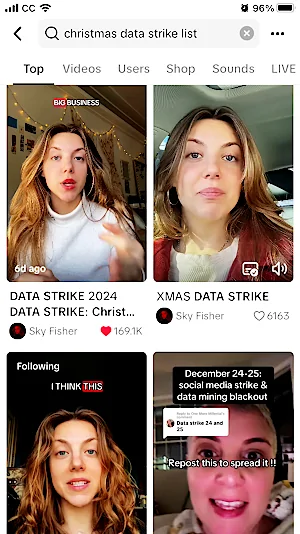
TikTok user Sky Fisher proposed the Dec. 24-25, 2024, “data strike.” The event was to protest surveillance and invasive advertising, and the lack of privacy tools allowing people to have a say in what happens with their personal data.
Analyzing and selling your private data—also known as surveillance capitalism—helps corporations track market trends and inflate profits. Most social media giants are repeat offenders.
According to citizen advocates, boycotts and demonstrations are also a challenge to violent insurance companies, predatory employers, greedy landlords, price-gouging grocers, plundering bankers, the massive government failure to provide a living wage, etc.
Ordinary Americans are sending a message of solidarity and resistance to billionaires and their .
Targeted concerns how the wealthy and well-connected target regular people, and how people are pushing back.
Report problems
Contacting me is a much more efficient and honest way of addressing issues than bringing a lawsuit against the author(s). Bringing a lawsuit instead of asking for a revision reveals the motives of those who abuse the legal system to intimidate citizen journalists while seeking to retain their employees’ stolen wages.
I may be reached via the Contact page or on Bluesky or Facebook.
NOTE: This website has always included my contact information.
Comments?
Please use the button below to comment on this article...